


95×4 3-Phase 4-Wire Underground Aluminum Cable: This cable adopts a 4-core design, with each core having a cross-sectional area of 95mm². This specification enables it to be well adapted to 3-phase 4-wire power transmission systems and meet the corresponding current-carrying capacity requirements during power transmission. Tests have shown that under appropriate environmental conditions, its current-carrying capacity can stably support power transmission in medium and high-voltage underground power distribution scenarios. The outer diameter of the cable is precisely designed to not only ensure the reasonable arrangement of internal cores and various layers but also adapt to the pipe size requirements for underground laying. At the same time, parameters such as the bending radius of the cable meet the standards for underground laying, facilitating construction personnel to carry out laying operations in the limited underground space.
3×185 + 95mm High-Voltage Cable: It consists of 3 phase lines with a cross-sectional area of 185mm² and 1 neutral line with a cross-sectional area of 95mm². The 3 phase lines can undertake the task of high-voltage power transmission, and the 1 neutral line plays a role in balancing the three-phase current, meeting the three-phase balance requirement for high-voltage power transmission. The overall current-carrying capacity of this cable is relatively large, enabling it to adapt to high-voltage and high-power power transmission scenarios. The thickness and voltage withstand level of its insulation layer are strictly designed in accordance with relevant standards for high-voltage cables, and it can withstand voltage impacts during high-voltage power transmission. Parameters such as the outer diameter and weight of the cable are also optimized to facilitate transportation and underground laying while ensuring performance.
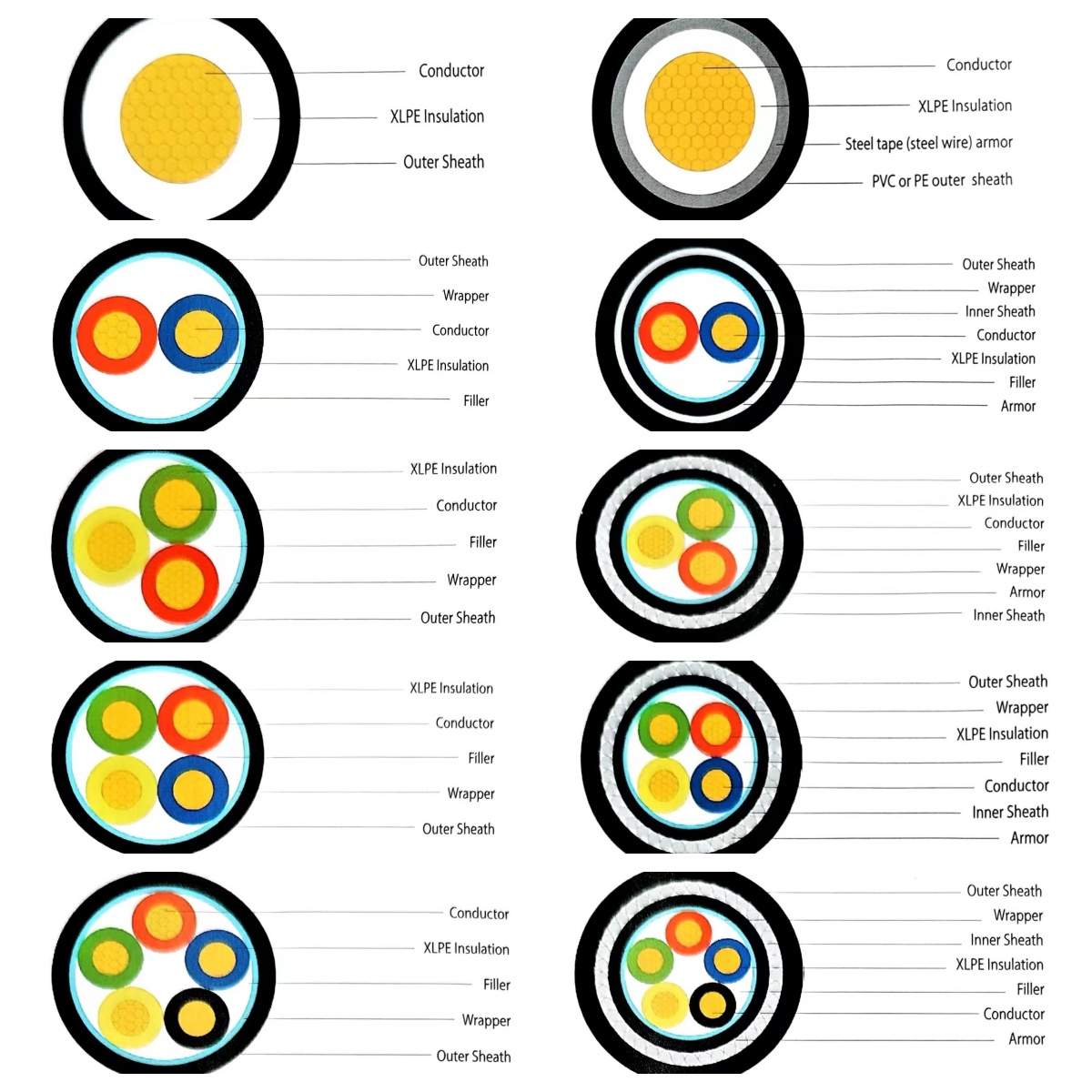
95×4 3-Phase 4-Wire Underground Aluminum Cable: Due to its adaptability to 3-phase 4-wire systems and medium and high-voltage transmission capacity, it is suitable for medium and high-voltage underground power distribution scenarios. In the underground power distribution system of residential communities, it can serve as an underground trunk line to transmit power from the community's distribution room to the distribution boxes of each building, providing stable power support for residents' daily electricity use. In underground power distribution in industrial parks, it can connect the total power distribution devices of the industrial park with the power distribution systems of various factories, meeting the electricity needs of various industrial equipment in the park. In addition, it can also play an important role in underground power distribution lines of some small and medium-sized commercial centers, ensuring the normal electricity use of equipment such as air conditioners, lighting, and elevators in shopping malls.
3×185 + 95mm High-Voltage Cable: With high-voltage and high-power transmission capacity, it is mainly used in higher-power high-voltage power transmission scenarios. In underground transmission lines from substations to users, it can safely and efficiently transmit high-voltage power output from substations to power distribution facilities on the user side, meeting the electricity needs of large areas. In the underground power supply network of large industrial plants, it can provide sufficient and stable high-voltage power for large industrial equipment such as large machine tools and steel-making equipment, ensuring the smooth progress of industrial production. At the same time, in underground high-voltage transmission trunk lines of some cities, this cable can also undertake the important task of power transmission, reducing the occupation of urban space by overhead transmission lines.
In terms of materials:
Conductors: The conductors of both cables are made of aluminum. Aluminum has the characteristic of being lightweight, which makes the cable more convenient during transportation, reducing transportation costs; during underground laying, it also reduces the handling burden of construction personnel and improves construction efficiency. Moreover, the cost of aluminum is relatively low, which can reduce the overall cost of the cable on the premise of ensuring that the conductivity meets the requirements, resulting in high cost performance.
Insulation Layer: Although the Insulation Material is not clearly specified, combined with the characteristics of high-voltage cables, it is usually equipped with a high-voltage resistant insulation layer such as cross-linked polyethylene (XLPE). The XLPE insulation layer has excellent high-voltage resistance, can withstand the electric field effect during high-voltage power transmission, and is not easy to be broken down. At the same time, it has good chemical corrosion resistance and aging resistance, and can maintain stable insulation performance for a long time in the underground humid environment with certain soil chemical substances, ensuring the safety of power transmission.
Sheath Layer: To adapt to the underground laying environment, the sheath layers of both cables usually use wear-resistant, corrosion-resistant, and moisture-proof materials. This kind of sheath layer can resist the pressure and friction of underground soil as well as the erosion of groundwater, protect the internal cores and insulation layers from damage, and extend the service life of the cable.
In terms of style:
95×4 3-Phase 4-Wire Underground Aluminum Cable: It adopts a 4-core cabling style, with 4 Cores combined in a certain stranding way and wrapped with a sheath layer on the outside. This style has a compact structure and strong integrity, which can reduce the occupied space during underground laying, and at the same time, can improve the mechanical strength of the cable to resist external impacts in the underground environment.
3×185 + 95mm High-Voltage Cable: 3 phase lines and 1 neutral line are stranded together to form an integral structure, with a sheath layer also wrapped on the outside. This style can ensure the stable relative position between phase lines and neutral lines, which is conducive to three-phase balance during power transmission, and at the same time, facilitates construction personnel to carry out laying and installation. Both cables have a relatively regular appearance and smooth surfaces, which are easy to pass through underground pipes.
Production Process of 95×4 3-Phase 4-Wire Underground Aluminum Cable:
Conductor Production: High-quality aluminum materials are selected, first smelted to remove impurities to improve the purity of aluminum, and then made into aluminum rods through rolling processes. Then, the aluminum rods are drawn into Aluminum Wires of the required diameter through wire drawing equipment, and then multiple Aluminum Wires are stranded together in a specified stranding way to form a conductor with a single-core cross-sectional area of 95mm². During the stranding process, the stranding pitch and tension are strictly controlled to ensure the roundness and conductivity of the conductor.
Insulation Layer Extrusion: Special extrusion equipment is used to heat and melt the insulation material, then uniformly extrude and wrap it around the conductor to form an insulation layer. During the extrusion process, parameters such as extrusion temperature and speed are accurately controlled to ensure that the insulation layer has uniform thickness, a smooth surface, and is closely combined with the conductor without defects such as bubbles and impurities.
Cabling: 4 Cores wrapped with insulation layers are cabled in a certain stranding way. During the cabling process, appropriate filling materials are filled to make the cable structure round. Then, a layer of binding tape is wrapped around the outside to fix the position of the cores.
Sheath Extrusion: Wear-resistant, corrosion-resistant, and moisture-proof sheath materials are selected, extruded through an extruder, and wrapped around the cabled cable to form a sheath layer. After extrusion, the cable is cooled and solidified to make the sheath layer closely combine with the internal structure.
Inspection: The finished cable undergoes appearance inspection, size measurement, and electrical performance testing (such as insulation resistance testing and voltage withstand testing) to ensure that the cable quality meets the standards.
Production Process of 3×185 + 95mm High-Voltage Cable:
Conductor Production: Similar to the 95×4 cable, 3 phase line conductors with 185mm² and 1 neutral line conductor with 95mm² are produced respectively. During the production process, parameters of each link are strictly controlled to ensure the conductor quality.
Insulation Layer Extrusion: Due to being a high-voltage cable, the requirements for the insulation layer are higher. High-quality high-voltage resistant insulation materials are used. During the extrusion process, in addition to controlling conventional parameters, the thickness and uniformity of the insulation layer are more strictly controlled to ensure its high-voltage resistance. After extrusion, special treatments such as cross-linking may be required to further improve the performance of the insulation layer.
Cabling: 3 phase lines and 1 neutral line are cabled in a designed stranding way, and the positions of each core are reasonably arranged to ensure three-phase balance. Filling materials are filled and binding tapes are wrapped during the cabling process.
Sheath Extrusion: Sheath materials suitable for high-voltage cables and adaptable to the underground environment are selected, wrapped around the cabled cable through an extruder, and formed into a sheath layer after cooling and solidification.
Inspection: In addition to conventional inspection items, more stringent high-voltage withstand testing and partial discharge testing are required to ensure that the cable can operate safely and stably in a high-voltage environment.
Packaging Materials: Both cables are packaged with steel cable reels. Steel cable reels have the characteristics of high strength and high load-bearing capacity, which can bear the weight of the cable and external impacts during transportation and hoisting, and protect the cable from damage. At the same time, steel cable reels have good moisture-proof performance and can prevent the cable from getting damp to a certain extent.
Packaging Methods: The cable is neatly wound on the steel cable reel, and appropriate tension is maintained during the winding process to avoid the cable being loose or twisted. A layer of moisture-proof film is wrapped around the outer layer of the cable to further enhance the moisture-proof effect. On the side of the cable reel, information such as the model, specification, length, production date, and manufacturer of the cable is clearly marked for easy identification and traceability. To prevent the cable from slipping off the cable reel during transportation, special fixing devices are used to fix both ends of the cable.
Packaging Requirements: The packaging must be firm and reliable, and the size and strength of the cable reel must match the specification and length of the cable. The packaged cable must be able to adapt to various environments during transportation, such as vibration, bumps, and temperature changes, to ensure that the cable remains intact when it reaches the destination. At the same time, the packaging should be easy to hoist and transport, and special hoisting holes are set on the cable reel to facilitate loading and unloading with hoisting equipment.
Transportation Methods: According to the transportation distance and the number of cables, road transportation or railway transportation can be selected. For short-distance transportation, large trucks are used for transportation. The trucks are equipped with special fixing devices to fix the cable reels firmly to prevent movement during transportation. For long-distance transportation, railway transportation is chosen. Railway transportation has the characteristics of good stability and large transportation volume, which can reduce bumps and impacts on the cable during transportation.
Transportation Precautions: Before transportation, a comprehensive inspection of the cable reel is carried out to ensure that the cable is wound firmly and the fixing devices are reliable. During transportation, avoid severe collision and extrusion of the cable reel, and it is strictly forbidden to place the cable reel upside down or tilted. Obvious warning signs such as "Handle with Care" and "Do Not Invert" are set on the transport vehicle to remind transport personnel to pay attention. At the same time, avoid the cable being exposed to the sun, rain, and freezing during transportation. In severe weather conditions, the cable should be covered for protection. During transportation, drivers should drive steadily and avoid sudden braking and sharp turns to reduce the shaking of the cable reel.
Transportation Tracking: Arrange special personnel to track the transportation process and keep abreast of the transportation status of the cable. Keep in contact with the transport driver to grasp the transportation progress and location. In case of transportation delays, poor road conditions, and other situations, take timely countermeasures to ensure that the cable can arrive at the destination on time and safely.
Delivery Process: After receiving the customer's order, the sales staff promptly transmit the order information to the warehouse management personnel. The warehouse management personnel check the model, specification, and quantity of the cable according to the order information to ensure that the goods are consistent with the order. Then, conduct a pre-shipment inspection of the cable to check whether the packaging is intact and the logo is clear. After passing the inspection, arrange transport vehicles and go through the delivery procedures. After loading and fixing the cable on the transport vehicle, inform the customer of the transportation information, such as the license plate number of the transport vehicle, the driver's contact information, and the estimated arrival time, to facilitate the customer's preparation for receipt.
Delivery Time: When there is sufficient inventory, delivery is generally completed within 2-3 working days after receiving the order. For cables with customized specifications, the delivery time is determined according to the production cycle, and timely communication is made with the customer to inform them of the production progress and estimated delivery time, allowing the customer to arrange their time reasonably.
Delivery Notification: After the cable is shipped, notify the customer in a timely manner via SMS, email, or phone call, inform the customer that the cable has been shipped, and provide relevant transportation information to facilitate the customer to track the goods.
Sample Provision: For customers in need of samples, cable samples of corresponding specifications can be provided. The length of the 95×4 3-phase 4-wire underground aluminum cable sample is generally 1-2 meters, and the length of the 3×185 + 95mm high-voltage cable sample is also 1-2 meters. The specification and material of the sample are consistent with the formal product and can accurately reflect the actual situation of the product.
Sample Cost: The sample itself is provided to the customer free of charge, but the transportation cost of the sample is borne by the customer. The customer can choose to pay the freight by cash on delivery or arrange for shipment by the manufacturer after paying the freight in advance.
Sample Delivery: After receiving the customer's sample application and confirming relevant information, the staff will prepare the sample within 1-2 working days. The sample is simply packaged to prevent damage during transportation. A reliable express logistics company is selected for delivery, and the express waybill number is informed to the customer before delivery to facilitate the customer to check the logistics information of the sample. At the same time, product description materials are attached to the sample to help the customer better understand the performance and characteristics of the sample.
Quality Assurance: Both cables provide a quality guarantee period of 18-24 months. Within the quality guarantee period, if the cable fails due to its own quality problems, such as conductor breakage and insulation layer breakdown, after inspection and confirmation by professionals, the manufacturer will provide customers with free repair or replacement services.
After-Sales Service Response: A special after-sales service hotline and email are set up. Customers can contact after-sales service personnel at any time if they encounter any problems during use. After receiving customer feedback, after-sales service personnel will respond within 24 hours, understand the specific situation of the problem, and provide preliminary solutions.
On-Site Service: For problems that need on-site handling, such as faults in the laying or use of cables, the manufacturer will send professional technical personnel to conduct on-site investigation and handling. After arriving at the site, technical personnel will analyze the cause of the fault and take effective solutions to restore power supply as soon as possible.
Technical Support: Provide customers with professional technical support services, including cable selection suggestions, laying and installation guidance, and use and maintenance consultation. When customers purchase cables, technical personnel recommend appropriate cable models and specifications according to the customer's use scenarios and power loads. If customers encounter technical problems during cable laying and use, technical personnel will provide detailed guidance and solutions.
Customer Feedback: A customer feedback mechanism is established to regularly collect customers' opinions and suggestions on product quality and services. Reasonable suggestions put forward by customers are studied and adopted in a timely manner to continuously improve product and service quality. At the same time, classify and sort out customer feedback problems, analyze the causes of the problems, and take preventive measures to avoid similar problems from happening again.


Hongtai Kablo Teknoloji Co., Ltd
E-posta: Export@qlcables.com
sales@qlcables.com
Tel/whatsapp:+86-18032066271
Ekle : Xiaokou Endüstriyel Kalkınma Bölgesi, Ningjin County, Xingtai City , Hebei Eyaleti, Çin
Telif Hakkı © Hongtai Cable Technology Co., Ltd Teknik Destek:Ronglida teknolojisi
Bu web sitesi, web sitemizde en iyi deneyimi yaşamanızı sağlamak için çerezleri kullanır.
 English
 Español
 Portugues
 Pусский
 Français
 العربية
 ไทย
ไทย Indonesia
 Tiếng Việt



 Telefon
 Posta
Posta