Detailed Introduction to 5X10mm², 5X16mm² Cu/XLPE/Fr-PVC/Swa/Fr-PVC Armored Power Cables
I. From the Perspective of the Product Itself
(1) Specification Parameters
The 5X10mm² and 5X16mm²
Copper Core XLPE/Fr-PVC/Swa/Fr-PVC armored
Power Cables have rich and precise specification parameters, laying a solid foundation for their stable application in various fields.
In terms of conductor specifications, both cables adopt a 5-core design, with single-core cross-sectional areas of 10mm² and 16mm² respectively. The conductors are stranded from high-purity electrolytic copper with a purity of over 99.95%, which endows them with excellent conductivity. The DC resistance of the 10mm²
Cable Conductor at 20℃ is ≤1.83Ω/km, and that of the 16mm² cable is ≤1.15Ω/km, which is much lower than the industry standard. This can effectively reduce losses during power transmission and improve transmission efficiency.
For the insulation layer, XLPE (cross-linked polyethylene) material is used, which forms a three-dimensional network structure after high-temperature cross-linking treatment. The insulation thickness of the 10mm² cable is 1.4mm, and that of the 16mm² cable is 1.6mm. This insulation layer has a temperature resistance rating of 90℃, an insulation resistance of ≥1000MΩ·km, and can withstand a 12kV/5min voltage withstand test without breakdown. Its insulation performance is far superior to ordinary PVC materials, providing reliable insulation protection in complex electrical environments.
The Fr-PVC (flame-retardant polyvinyl chloride) inner sheath is an important part of the cable, with an oxygen index of ≥32, complying with the GB/T 18380 flame retardant standard. The inner sheath tightly wraps around the outside of the insulation layer, which not only further enhances the insulation performance of the cable but also forms a carbonized layer in case of fire, effectively blocking the spread of flames and providing guarantee for the fire safety of the cable.
The middle Swa (steel wire armoring) layer uses galvanized low-carbon steel wires with a diameter of 1.6-2.0mm, wrapped around the outside of the inner sheath in a spiral winding manner, with an armoring density of ≥80%. The tensile strength of the armoring layer of the 16mm² cable reaches more than 15kN, which enables the cable to have strong resistance to mechanical impact and pressure, and can also effectively prevent gnawing by rats and ants, and withstand external forces such as soil pressure during underground laying.
The outermost Fr-PVC outer sheath has a thickness of ≥2.0mm, which also meets the flame retardant requirements, forming a double fire barrier with the inner sheath. The outer sheath has excellent acid and alkali resistance and UV aging resistance, which can protect the internal structure of the cable from erosion by the external environment and prolong the service life of the cable.
Both cables have a rated voltage of 0.6/1kV, in line with the GB/T 12706.1 standard, and are suitable for medium and low-voltage distribution systems. The long-term operating temperature range is -40℃ to 90℃, and it can withstand a high temperature of 250℃ in case of a short circuit (within 5s), which can adapt to working needs in different ambient temperatures.
Current-carrying capacity is an important parameter to measure the power transmission capacity of the cable. The current-carrying capacity of the 5X10mm² cable when laid in air is 65-85A, and when laid underground is 55-70A; the current-carrying capacity of the 5X16mm² cable when laid in air is 85-110A, and when laid underground is 70-90A. They can be adapted to distribution systems of different powers to meet diversified power transmission needs.
The bending radius of the cable is also clearly specified, which is 12 times the outer diameter of the cable in static conditions and 20 times in dynamic conditions. This parameter allows the cable to be conveniently laid in narrow spaces, improving the
Flexibility of installation.
(2) Characteristic Applications
The 5X10mm² and 5X16mm² copper
Core XLPE/Fr-PVC/Swa/Fr-PVC
Armored Power cables, relying on their excellent performance, have distinctive applications in many fields.
In the industrial field, this cable is an ideal power cable for connecting high and low-voltage distribution cabinets to large equipment. For example, in the workshop of a large factory, equipment such as motors above 100kW requires stable and strong power supply. The 5X16mm² cable can meet its current-carrying capacity requirements, and the steel wire armoring layer can effectively resist the vibration and impact generated during the operation of the equipment, ensuring the stability of power transmission and reducing production interruptions caused by cable failures. For industrial equipment with relatively small power, the 5X10mm² cable can provide reliable power support at a more economical cost.
The power system of high-rise buildings has extremely high requirements for the safety and reliability of cables, and this cable also has great use in this field. In the strong electric shaft of high-rise buildings, the cable needs to bear a certain mechanical pressure and the possible fire risk. Its flame-retardant property (both inner and outer sheaths are made of Fr-PVC material) can significantly reduce the fire hazard, and it is especially suitable for emergency power circuits. In case of emergencies such as fires, the cable can maintain power transmission for a certain period of time, providing power guarantee for personnel evacuation and fire rescue.
The environment of new energy photovoltaic
Power Stations is relatively special, especially in cold regions, where the temperature in winter may be as low as -40℃. The long-term operating temperature range of this cable includes -40℃, which can maintain good performance in low-temperature environments, ensuring the stable power supply of the photovoltaic power station in winter. At the same time, its UV aging-resistant outer sheath can resist long-term exposure to sunlight, prolonging the service life of the cable in outdoor environments and reducing maintenance costs.
Underground pipe gallery projects are an important part of urban infrastructure, and cables in them need to face various challenges such as groundwater corrosion, soil pressure, and mechanical collision. The double sheaths (inner and outer Fr-
PVC Sheaths) and steel wire armoring layer of the 5X10mm² and 5X16mm²
Armored Power Cables form a strong protection system, which can effectively resist the corrosion of groundwater and various mechanical damages, ensure the safe and stable power transmission in the pipe gallery, and provide power guarantee for the normal operation of the city.
In addition, this cable can also play an important role in some large public facilities such as gymnasiums, airports, railway stations and other places. These places have many electrical equipment, large power demand, and high requirements for the safety and durability of cables. The high current-carrying capacity, flame retardancy and mechanical protection performance of the cable can meet their complex power distribution needs and ensure the smooth progress of public activities.
Compared with ordinary non-
Armored Cables, the service life of this armored cable is extended by more than 30%. Although the initial purchase cost may be higher, from the perspective of the whole life cycle, it can significantly reduce the replacement and maintenance costs, and has higher cost performance.
(3) Material and Style
In terms of material selection and style design, the 5X10mm² and 5X16mm² copper core XLPE/Fr-PVC/Swa/Fr-PVC armored power cables are fully combined with their performance requirements and use scenarios, showing excellent quality.
The
Conductor Material is high-purity electrolytic copper with a purity of over 99.95%. High-purity copper has excellent conductivity, which can minimize losses during current transmission and improve power transmission efficiency. At the same time, electrolytic copper has good ductility and toughness, which is convenient for stranding into the required conductor structure, and is not easy to break during long-term use, ensuring the conductive stability of the cable.
The insulation layer is made of XLPE (cross-linked polyethylene) material. After high-temperature cross-linking treatment, the molecular structure of this material forms a three-dimensional network, endowing it with excellent temperature resistance and insulation performance. Compared with ordinary PVC
Insulation Materials, XLPE has a higher temperature resistance level, can remain stable at a long-term working temperature of 90℃, and has high insulation resistance and strong anti-aging performance, which greatly improves the safety, reliability and service life of the cable.
Both the inner sheath and the outer sheath are made of Fr-PVC (flame-retardant polyvinyl chloride) material, which has good flame retardant performance, with an oxygen index of ≥32, complying with strict flame retardant standards. In case of fire, it can quickly form a carbonized layer to prevent the spread of flames, delay the burning speed of the cable, and gain time for personnel evacuation and fire rescue in case of fire. At the same time, Fr-PVC material also has certain chemical corrosion resistance, which can resist the erosion of acids, alkalis and other substances and protect the internal structure of the cable.
The steel wire armoring layer is made of galvanized low-carbon steel wires with a diameter of 1.6-2.0mm. Low-carbon steel wires have high mechanical strength, and after galvanizing treatment, their corrosion resistance is significantly improved, which can effectively resist corrosion from the external environment and prolong the service life of the armoring layer. The spiral winding method makes the armoring layer tightly wrap around the outside of the cable, forming a solid mechanical protection, enhancing the cable's resistance to impact, pressure and gnawing by rats and ants.
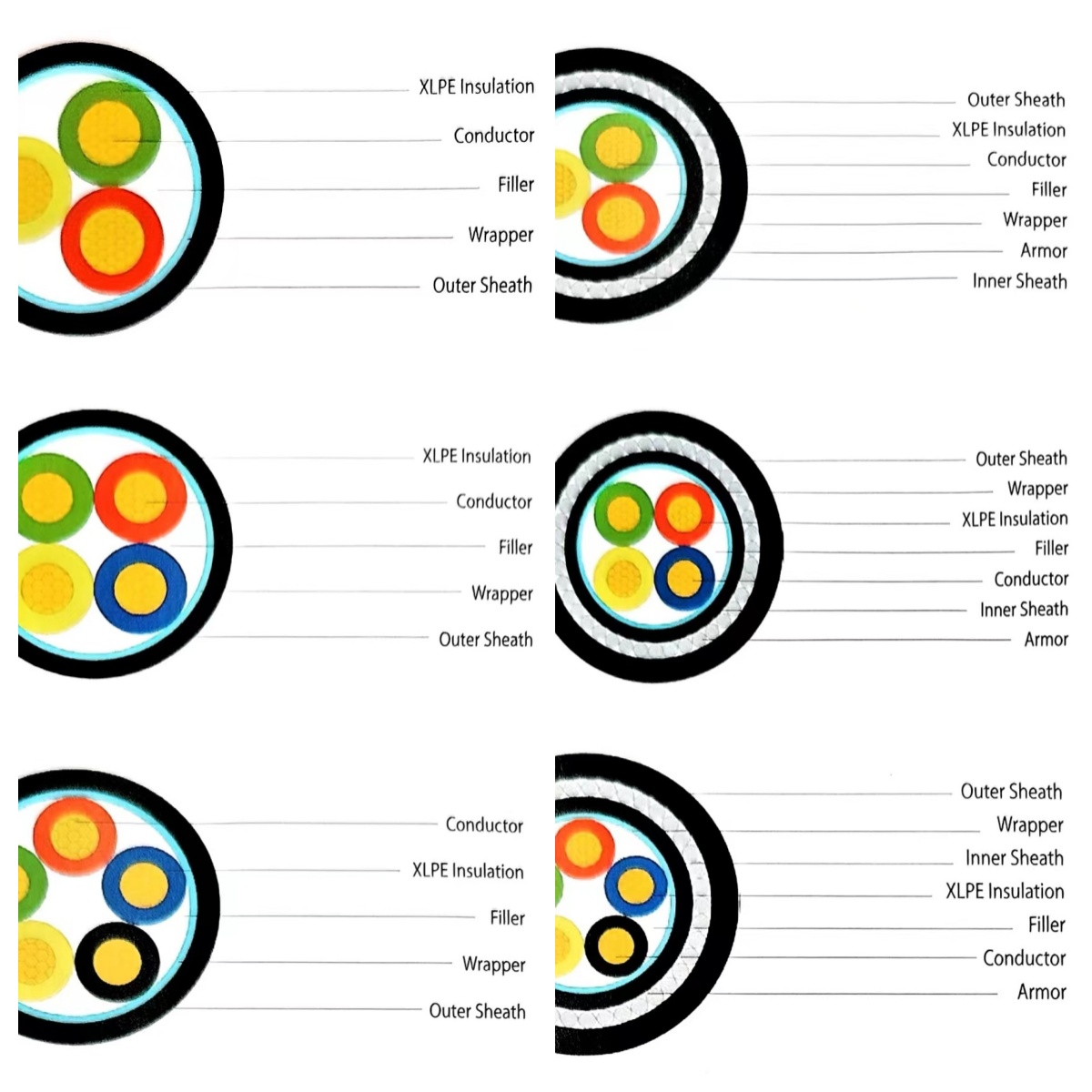
In terms of style, the overall structure of the cable is compact with distinct layers. 5
Copper Conductors are arranged in parallel, and each conductor is sequentially coated with an XLPE insulation layer, then jointly wrapped by a Fr-PVC inner sheath, then outward is a spiral-wound steel wire armoring layer, and the outermost layer is a Fr-PVC outer sheath, forming a complete whole. The color of the cable is usually black, which is not only dirt-resistant but also can absorb heat, reducing the impact of direct sunlight on the cable temperature, which is beneficial to the heat dissipation of the cable. The surface of the cable is printed with clear marks, including product model, specification, rated voltage, manufacturer and other information, which is convenient for users to identify and manage.
In addition, the cross-section of the cable is circular. This design makes the cable bear force evenly during laying, easy to bend and install, and also ensures the close combination between various layers of structures, improving the overall stability of the cable.
(4) Production Process
The production process of 5X10mm² and 5X16mm² copper core XLPE/Fr-PVC/Swa/Fr-PVC armored power cables is complex and rigorous, and each link is strictly controlled to ensure that the product quality meets relevant standards and requirements.
The production of conductors is the first step in cable manufacturing. First, high-purity electrolytic copper ingots are smelted to remove impurities, obtaining pure copper liquid. Then, the copper liquid is made into copper rods through continuous casting and rolling processes, and the diameter of the copper rods is controlled according to the specifications of the final conductor. Next, the copper rods enter the wire drawing equipment and are drawn into fine-diameter
Copper Wires through multiple drawing dies. During the wire drawing process, it is necessary to accurately control the drawing speed, temperature and lubrication conditions to ensure that the copper wires have uniform diameter, smooth surface and good mechanical properties. After that, according to the cross-sectional area requirements of the cable conductor, multiple copper wires are stranded in a certain stranding way to form 5 conductors of the required specifications (10mm² and 16mm²). During the stranding process, it is necessary to ensure that the tension of each copper wire is uniform and the stranding pitch is consistent to ensure the roundness and flexibility of the conductor.
The extrusion of the insulation layer is one of the key processes. XLPE material is added into the extruder, heated and melted, and then uniformly coated on the surface of each copper conductor through a special die to form an insulation layer. During the extrusion process, it is necessary to accurately control the extrusion temperature, pressure and speed to ensure that the insulation layer has uniform thickness, smooth surface, and is closely combined with the conductor without bubbles, impurities and other defects. After extrusion, the
Insulated Conductor enters the cross-linking pipe for high-temperature cross-linking treatment. Through the action of high temperature and high pressure, the XLPE molecules undergo cross-linking reaction to form a three-dimensional network structure, thereby improving its temperature resistance and insulation performance. The cross-linked insulated conductor needs to be cooled and shaped to maintain its shape and performance stability.
The extrusion of the inner sheath follows the insulation layer. Fr-PVC material is added into another extruder, heated and melted, and then uniformly coated on the outside of the 5 insulated conductors through a die to form a Fr-PVC inner sheath. The function of the inner sheath is to integrate multiple insulated conductors and provide initial flame retardancy and protection. During the extrusion process, it is necessary to control the process parameters to ensure that the sheath has uniform thickness, is closely attached to the insulation layer, and has no cracks, delamination and other problems.
Steel wire armoring is an important link to enhance the mechanical performance of the cable. An automatic armoring machine is used to uniformly wrap galvanized low-carbon steel wires with a diameter of 1.6-2.0mm around the outside of the inner sheath in a spiral winding manner. During the winding process, it is necessary to accurately control the tension and winding density of the steel wires (≥80%) to ensure that the armoring layer is tight and uniform without loosening, overlapping and other phenomena. For 16mm² cables, due to their larger specifications, it is necessary to select steel wires with larger diameters or increase the number of steel wires to ensure that the tensile strength of the armoring layer reaches more than 15kN.
Finally, the outer sheath is extruded. Fr-PVC material is added into the extruder, heated and melted, and then coated on the outside of the armoring layer through a die to form an outer sheath. The thickness of the outer sheath is ≥2.0mm. During the extrusion process, it is also necessary to ensure that the thickness is uniform, the surface is flat, it is closely combined with the armoring layer, and has good flame retardant performance and environmental resistance. After the extrusion of the outer sheath is completed, the cable undergoes cooling, traction, cutting and other processes to form finished cables of a certain length.
Throughout the production process, quality inspection runs through. From the inspection of raw materials (such as the purity of copper, the performance of XLPE and Fr-PVC materials, the strength of steel wires and the quality of galvanized layers, etc.), to the inspection of semi-finished products in each process (such as the diameter and resistance of conductors, the thickness and voltage withstand performance of insulation layers, the thickness and flame retardant performance of inner and outer sheaths, the density and tension of armoring layers, etc.), to the comprehensive performance testing of finished cables (such as overall voltage withstand test, insulation resistance test, bending performance test, flame retardant performance test, etc.), it is ensured that each batch of cables meets relevant standards and technical requirements. Only cables that pass strict inspection can leave the factory for sale.
II. From the Perspective of General Product Information
(1) Packaging
The packaging design of 5X10mm² and 5X16mm² copper core XLPE/Fr-PVC/Swa/Fr-PVC armored power cables fully considers the characteristics of the product and the needs of transportation and storage, aiming to protect the cable from damage during the circulation process and ensure product quality.
For coiled cables, solid wooden cable reels are usually used for packaging. Wooden cable reels are made of high-quality hardwood, which has high strength and bearing capacity, and can bear the weight of the cable and external impact during transportation. The size of the cable reel is determined according to the length and specification of the cable. The 10mm² and 16mm² cables have different weights and outer diameters, and the matched cable reel sizes are also different. Generally speaking, the maximum length of each reel of cable is 1000 meters. This length design is not only convenient for transportation but also can reduce the number of joints during installation.
When the cable is wound on the cable reel, it is necessary to strictly control the winding tension to make the cable tightly and neatly arranged on the cable reel, avoiding looseness, distortion or mutual friction. After winding, the outer layer of the cable is wrapped with a thick plastic film, which has good moisture-proof and dust-proof performance, and can effectively isolate external moisture, dust and other impurities, protecting the outer sheath of the cable from pollution and damage. On both sides of the cable reel, solid baffles are installed, and the height of the baffles is higher than the winding height of the cable, which can prevent the cable from slipping during transportation and handling.
A metal shaft sleeve is arranged at the central axis of the cable reel, which is convenient for loading, unloading and handling with forklifts, cranes and other equipment. A detailed label is pasted on the side of the cable reel, which clearly indicates the product name, model specification (5X10mm² or 5X16mm²), length, rated voltage, production batch number, production date, implementation standard, manufacturer name and contact information, etc., which is convenient for users to identify, accept and trace the product.
For small batches or short-length cables, wooden boxes may be used for packaging. The wooden boxes are made of solid wood boards, with moisture-proof paper or foam materials padded inside to fix the cables in the wooden boxes and prevent them from shaking and colliding during transportation. The corresponding product labels and transportation marks are also pasted on the wooden boxes.
During storage, packaged cables should be stored in a dry, ventilated, dark warehouse away from heat sources and corrosive substances. The cable reel should be placed on a flat ground and padded with wooden blocks to keep a certain distance between the cable reel and the ground to prevent moisture. At the same time, avoid stacking heavy objects on the cable reel to prevent damage to the cable. For cables packed in wooden boxes, avoid stacking too high to prevent the bottom wooden boxes from being deformed by pressure.
(2) Transportation
The transportation of 5X10mm² and 5X16mm² copper core XLPE/Fr-PVC/Swa/Fr-PVC armored power cables needs to strictly follow relevant regulations and operating procedures to ensure the safe transportation of the cables.
Before transportation, a comprehensive inspection of the cable packaging is required. Carefully check whether the cable reel is firm, whether the baffle is intact, whether the cable is wound neatly and tightly, whether the plastic film is well sealed, and whether the label is clear and complete. For cables packed in wooden boxes, check whether the wooden boxes are damaged or loose, and whether the internal cables are fixed firmly. If any problems are found in the packaging, they should be repaired or repackaged in time to meet the transportation requirements.
According to the quantity, specification and transportation distance of the cables, select appropriate transport vehicles. Semi-trailers or large trucks are usually used for long-distance transportation, and ordinary trucks can be used for short-distance transportation. The compartment of the transport vehicle should be kept clean and flat, without sharp debris, to avoid scratching the cable packaging and outer sheath. When loading the cables, use forklifts or cranes to hoist the cable reels or wooden boxes smoothly into the compartment. During the hoisting process, avoid collision and extrusion to prevent deformation of the cable reels, loosening of the cables or damage to the wooden boxes.
The cables should be placed reasonably in the compartment to ensure a stable center of gravity. For cable reels, they should be placed flat, and there should be a certain gap between adjacent cable reels to avoid mutual collision. If necessary, use steel wire ropes or chains to fix the cable reels to the fixed devices in the compartment. When fixing, pay attention to the moderate strength, which should not only prevent the cable reels from moving during transportation but also not be over-tightened to damage the cable reels or cables. For cables packed in wooden boxes, they should be stacked neatly, and the stacking height should not be too high. In addition, partitions should be placed between layers to prevent mutual extrusion.
During transportation, drivers must strictly abide by traffic rules, maintain stable driving, avoid violent operations such as sudden braking, sharp turns and speeding, and reduce the impact and vibration on the cables. When passing through bumpy sections, bridges, tunnels and other special sections, drive slowly to ensure driving safety and cable stability. At the same time, pay attention to preventing bad weather. In case of rain and snow, the cables should be covered to prevent moisture; in high-temperature weather, avoid the cables being exposed to the sun for a long time to prevent the outer sheath from aging due to high temperature.
Special personnel should be arranged for escort during transportation. The escorts should be familiar with the characteristics and transportation requirements of the cables, regularly check the fixing status and packaging of the cables, and deal with problems in time. If the transportation is delayed due to traffic jams, road maintenance, etc., the consignee should be informed in time of the expected arrival time.
After arriving at the destination, use appropriate equipment to unload the cables smoothly. Avoid collision and extrusion during unloading. After unloading, the escorts and the consignee shall jointly inspect the packaging, appearance and labels of the cables, and go through the handover procedures after confirmation.
(3) Delivery
The delivery process of 5X10mm² and 5X16mm² copper core XLPE/Fr-PVC/Swa/Fr-PVC armored power cables is standardized and orderly to ensure that the products are delivered accurately and timely to customers.
After receiving the customer's order, the sales department will first conduct a detailed verification of the order information. This includes confirming the product model (5X10mm² or 5X16mm²), quantity, delivery address, required delivery time, contact person and contact information, etc., to ensure that the order information is accurate and error-free. If there are any unclear or inconsistent parts in the order information, the sales staff will communicate with the customer in a timely manner to confirm, so as to avoid delivery errors caused by information deviations.
After the order is confirmed, the sales department will issue a delivery notice to the warehouse department. The warehouse staff will retrieve the corresponding cables from the inventory according to the requirements of the delivery notice. During the retrieval process, they will strictly abide by the first-in-first-out principle to ensure that the delivered cables are within the shelf life. At the same time, they will carefully check the retrieved cables, including whether the packaging is intact, whether the labels are clear and complete, and whether the product specifications and models are consistent with the order requirements. Only the cables that pass the inspection can be prepared for delivery.
For the cables that have passed the inspection, the warehouse staff will carry out packaging reinforcement if necessary to ensure that the cables can withstand the transportation process. Then, they will generate a delivery list, which clearly records the product information, customer information, delivery quantity, batch number and other contents. The delivery list is an important document for the handover between the warehouse and the logistics department, as well as for the customer to check and accept the goods.
The sales department will coordinate with the logistics company to arrange the appropriate transportation mode and vehicle according to the delivery time and destination. They will provide the logistics company with detailed delivery information, including the consignee's address, contact person, contact information, and precautions for transportation, to ensure that the logistics company can pick up and deliver the goods smoothly.
After the cables are shipped, the sales staff will promptly inform the customer of the shipment information, including the name of the logistics company, the waybill number, the estimated arrival time, the driver's contact information, etc. This allows the customer to know the transportation progress of the goods in time and make preparations for receiving the goods. At the same time, the sales department will track the logistics information, keep in close contact with the logistics company and the customer, and promptly handle any problems that may occur during transportation.
For customers with special delivery requirements, such as urgent delivery or designated delivery time, the sales department will communicate with the warehouse and logistics company in advance to formulate a special delivery plan to meet the customer's needs as much as possible.
(4) Samples
To help customers better understand the quality and performance of 5X10mm² and 5X16mm² copper core XLPE/Fr-PVC/Swa/Fr-PVC armored power cables, the company provides sample services, allowing customers to conduct on-site testing and evaluation.
Customers can apply for samples through various channels such as telephone, email, online platforms or on-site visits. When applying, customers need to specify the required product specifications (5X10mm² or 5X16mm²), the purpose of the sample (such as performance testing, project demonstration, etc.), the quantity required, and provide detailed contact information and delivery address.
After receiving the sample application, the sales department will review it in a timely manner. For applications that meet the sample provision standards, the sales staff will confirm the relevant information with the customer and then notify the warehouse to prepare the samples. For special sample requirements, such as samples with a specific length or with special connectors, the sales department will communicate with the production department to assess the feasibility and inform the customer of the processing time and related matters.
The warehouse will select qualified products from the inventory according to the sample application requirements, and conduct strict inspections on the samples to ensure that their quality and performance are consistent with the bulk products. The samples are then packaged in appropriate packaging to prevent damage during transportation. At the same time, relevant product information materials, such as product manuals, test reports, etc., are attached to help customers better understand the product.
The company will choose the appropriate transportation method according to the customer's location and the urgency of the sample. For domestic customers, express delivery is usually used to ensure that the samples can be delivered within 1-3 days; for foreign customers, international express services are selected to shorten the transportation time as much as possible. After the samples are shipped, the customer will be informed of the express number and tracking information so that the customer can track the sample logistics in time.
Customers can conduct various tests on the samples after receiving them, such as testing the conductor resistance, insulation performance, flame retardant performance, mechanical strength, etc. During the sample evaluation process, if the customer has any questions, the company's technical staff or sales staff will provide professional answers and technical support to help the customer better evaluate the product.
The sample service is usually free of charge, but the transportation cost may be borne by the customer or negotiated between the two parties. For customers who place formal orders after the sample evaluation, the company may refund the sample transportation cost according to the agreement, which not only helps customers reduce the cost of understanding the product but also promotes the establishment of cooperative relations between the two parties.
(5) After-sales Service
The company attaches great importance to the after-sales service of 5X10mm² and 5X16mm² copper core XLPE/Fr-PVC/Swa/Fr-PVC armored power cables and has established a sound after-sales service system to provide customers with timely and effective service support.
Warranty service is an important part of after-sales service. The product has a certain warranty period, usually 1-3 years from the date of delivery, and the specific warranty period may vary according to the product model and application scenario. During the warranty period, if the cable has quality problems (such as insulation breakdown, conductor failure, sheath cracking, etc.) due to manufacturing defects or material problems under normal use conditions, the customer can apply for warranty service. When applying, the customer needs to provide the purchase certificate, product model, batch number, and a detailed description of the problem. After receiving the warranty application, the company will send technical personnel to the site to inspect and confirm the problem. If it is confirmed that it is a quality problem within the warranty scope, the company will provide free repair, replacement or other solutions according to the actual situation to ensure that the customer's power system can resume normal operation as soon as possible.
For cable problems that exceed the warranty period or are caused by improper use, man-made damage, force majeure and other factors, the company provides paid maintenance services. The customer can contact the after-sales department to describe the problem, and the after-sales staff will evaluate the maintenance feasibility and provide a maintenance plan and cost quotation. The maintenance uses original accessories to ensure the maintenance quality, and the maintenance part will also have a certain warranty period.
Technical support is another important content of after-sales service. The company has a professional technical team composed of experienced engineers who can provide customers with technical guidance on product selection, installation, use, maintenance and other aspects. Customers can obtain technical support through telephone consultation, email communication, online video, on-site guidance and other ways. For example, when customers are not sure about the cable specification selection, the technical team can recommend the appropriate cable model according to the customer's power load, installation environment and other factors; when customers encounter problems in the installation process, the technical team can provide installation suggestions and solutions.
The company also conducts regular return visits to customers. The after-sales staff will contact customers through telephone, email or on-site visits to understand the use of the cable, whether there are any problems, and collect customer opinions and suggestions on the product and service. For key customers or large projects, the company will arrange special personnel to conduct on-site inspections regularly to check the operation status of the cable, find potential problems in time, and provide maintenance suggestions to ensure the long-term stable operation of the cable.
In addition, the company has set up a 24-hour after-sales service hotline and online service platform to accept customer complaints and suggestions at any time. The after-sales staff will respond to customer needs in a timely manner, track the processing progress of each problem, and ensure that each problem is properly solved, so as to improve customer satisfaction and enhance the company's reputation.


 English
 Español
 Portugues
 Pусский
 Français
 العربية
 ไทย
ไทย Indonesia
 Tiếng Việt



 Telefon
 Posta
Posta