


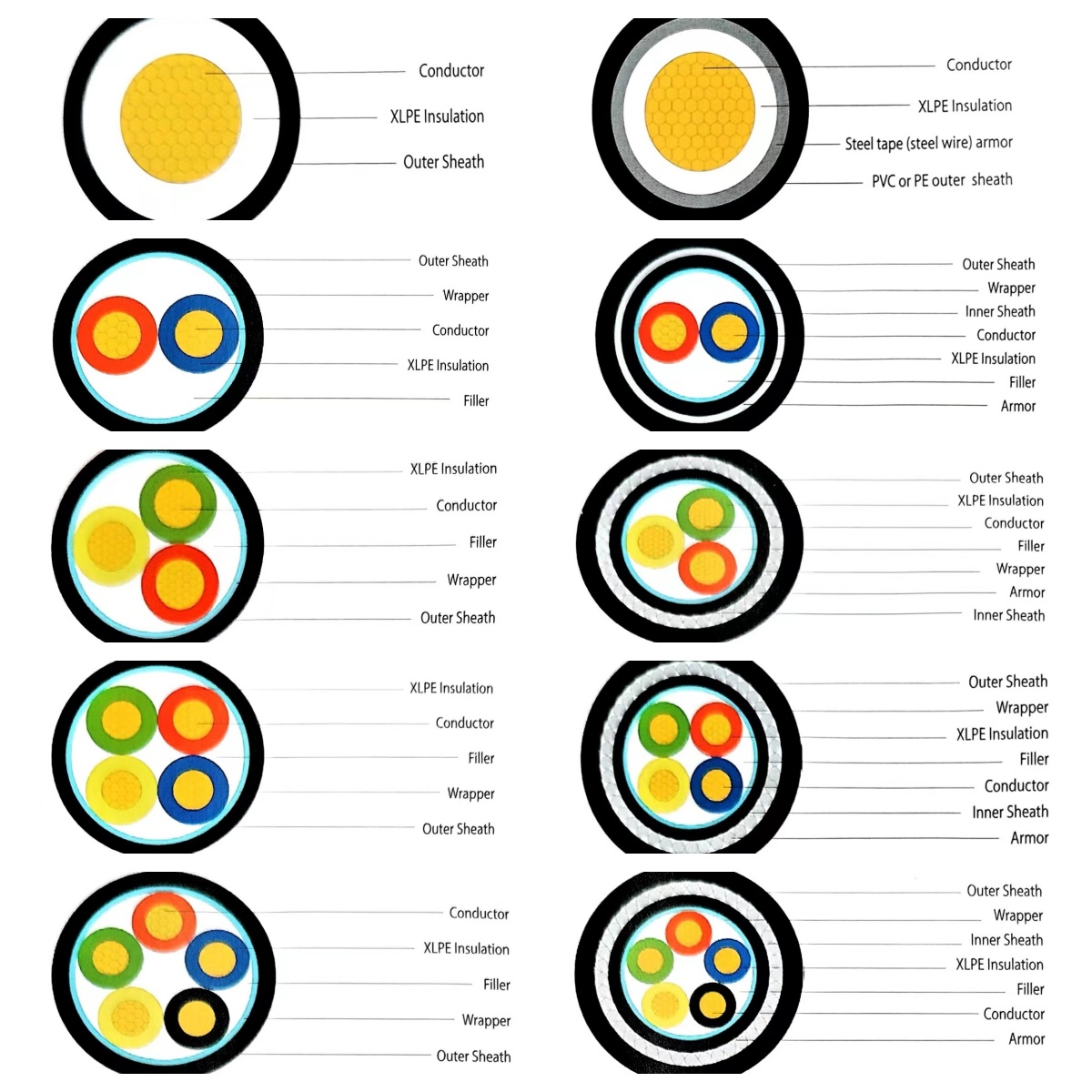
Main Lines of Large Factories: There are a large number of large-scale production equipment in large factories, such as heavy machine tools, large furnaces, and large compressors. These equipment have extremely high power and a huge demand for electricity. The 4×240mm² oxygen-free copper power cable can be used as the main line to efficiently and stably transmit external power to various production workshops in the factory, providing sufficient power support for these large equipment and ensuring the continuity of factory production. Due to the large and long-term power transmission load in the factory, the low-loss characteristic of the oxygen-free Copper Conductor can reduce the waste of electricity during transmission and lower the electricity cost of the factory.
Regional Distribution Trunk Lines: In some large areas, such as large industrial parks and newly developed large residential communities, it is necessary to distribute power from substations to various sub-areas through distribution trunk lines. These areas have a large total electricity consumption and involve many users and equipment. The 4×240mm² oxygen-free copper power cable, as a distribution trunk line, can undertake large-scale power transmission tasks, uniformly and stably transmit power to the distribution systems of various sub-areas, and ensure stable and reliable power supply in the area.
Power Distribution in Large Public Buildings: Large public buildings such as large shopping malls, gymnasiums, and convention centers have a large number of lighting equipment, air conditioning systems, elevator equipment, etc., with a large power load. This specification of cable can be used as the main power distribution line of these buildings to provide power for various equipment in the buildings. Its 4-core design can well adapt to the three-phase four-wire power supply demand in the buildings, and the stability of the oxygen-free copper conductor can ensure stable power supply during peak electricity consumption.
Power Supply for Large Data Centers: Large data centers have a large number of servers, switches, and other equipment. These equipment have extremely high requirements for the stability and reliability of power. Once there is a power outage or unstable power, it may cause huge losses. The 4×240mm² oxygen-free copper power cable can provide stable power supply for data centers. The low-resistance characteristic of the oxygen-free copper conductor can reduce fluctuations in the power transmission process and ensure the normal operation of the equipment.
Material
Conductor: Oxygen-free copper (Cuivre Sans Oxygène) is used as the conductor. Oxygen-free copper has extremely high purity and extremely low oxygen content, which makes its conductivity very excellent and can effectively reduce losses during current transmission. At the same time, oxygen-free copper has good ductility and toughness and is not easy to break during processing and use. Its oxidation resistance and corrosion resistance are also relatively prominent, which can extend the service life of the cable and reduce failures caused by conductor corrosion.
Insulation Layer: Cross-linked polyethylene (XLPE) is usually used as the insulation layer material. XLPE has good insulation performance, which can effectively prevent current leakage and ensure the safety of power transmission. It also has excellent temperature resistance and can maintain a stable insulation effect even when the cable heats up during long-term high-load operation. In addition, XLPE has high mechanical strength and good anti-aging performance, and can adapt to different environmental conditions.
Sheath: The sheath generally uses materials such as polyvinyl chloride (PVC) or polyethylene (PE). The PVC Sheath has good wear resistance and corrosion resistance, which can protect the internal structure of the cable from damage by the external environment, such as preventing mechanical collision and chemical corrosion. The PE sheath has good Flexibility and low-temperature resistance, and is suitable for use in cold areas or environments that require frequent bending.
Style
Manufacturing of Oxygen-Free Copper Conductor: First, strictly screen copper raw materials to remove impurities. Then put the copper raw materials into an oxygen-free smelting furnace for smelting. During the smelting process, isolate the air to prevent copper from being oxidized, and obtain high-purity oxygen-free copper liquid. The oxygen-free copper liquid is made into oxygen-free copper rods through a continuous casting process, and the diameter of the copper rods must meet the requirements of subsequent processing. Next, draw the oxygen-free copper rods into oxygen-free Copper Wires of the required diameter through a wire drawing machine. Finally, strand multiple oxygen-free copper wires together in a certain stranding way to form an oxygen-free copper conductor. During the stranding process, ensure the roundness and tightness of the conductor to ensure uniform and stable conductivity.
Insulation Layer Extrusion: Add XLPE Insulation Material into the extruder and heat to melt it. The molten XLPE material is uniformly extruded and coated on the outside of the oxygen-free copper conductor through a mold under the pressure of the extruder to form an insulation layer. During the extrusion process, precisely control parameters such as extrusion temperature, speed, and pressure to ensure that the insulation layer has a uniform thickness, a smooth surface, and is closely combined with the conductor, avoiding defects such as bubbles and depressions. After extrusion, cool and solidify the Insulated Core.
Cabling: Strand four cores covered with insulation layers in the specified stranding direction and pitch for cabling. During cabling, to ensure the roundness and structural stability of the cable, filling materials, usually polypropylene ropes, will be added in the center. During the cabling process, control the tension of each core to make the core stranding uniform and tight, avoiding looseness or distortion.
Sheath Extrusion: Add sheath materials (such as PVC or PE) into the extruder, heat and melt them, then extrude and coat them on the outside of the cabled cores to form a sheath. The process requirements for sheath extrusion are similar to those for insulation layer extrusion. It is necessary to ensure that the sheath has a uniform thickness, a smooth surface, and is closely combined with the internal structure to play a good protective role. After extrusion, cool the sheath to solidify and shape it.
Inspection and Testing: The finished cable needs to undergo a series of strict inspection and testing. Appearance inspection mainly checks whether the surface of the cable is damaged and whether the insulation layer and sheath are uniform; dimension inspection measures whether the outer diameter of the cable, the thickness of the insulation layer, the diameter of the conductor, etc. meet the standards; electrical performance testing includes insulation resistance testing and withstand voltage testing to ensure that the electrical performance of the cable meets the standards; mechanical performance testing such as tensile strength and bending performance testing to test whether the mechanical strength of the cable meets the use requirements. Only cables that pass all tests can leave the factory.
Packaging Materials: The 4×240mm² oxygen-free copper power cable usually uses large cable reels as packaging carriers. The cable reels are mostly made of metal because metal cable reels have high strength and bearing capacity and can bear the weight of the cable. On the outside of the cable reel, the cable will be wrapped with a plastic film, which can play a role in moisture-proof and dust-proof and protect the cable surface from pollution and damage. For some short-length cables, strong wooden boxes can also be used for packaging. Buffer materials such as foam boards and bubble films will be placed inside the wooden boxes to prevent the cables from colliding with each other during transportation.
Packaging Method: Wind the cable neatly on the cable reel. During winding, ensure that the cable is arranged closely without overlapping or twisting to avoid extrusion and wear of the cable. After winding, wrap the entire cable tightly with a plastic film, then fix the cable on the cable reel with a steel strip. When fixing, ensure that the force is moderate, which should not only prevent the cable from loosening but also avoid excessive extrusion and damage to the cable. The cable reel will be marked with the cable's model, specification, length, manufacturer, production date, and other information for easy identification and traceability.
Transportation Methods: Due to the large weight of the 4×240mm² oxygen-free copper power cable, road transportation or railway transportation is usually chosen. Road transportation has high flexibility and can directly deliver the cable to the customer's designated location, which is suitable for medium and short-distance transportation and small-batch transportation. Railway transportation has a large transport volume, relatively low cost, and good stability, which is suitable for long-distance transportation and large-batch transportation. When choosing the transportation method, factors such as transportation distance and customer needs will be considered comprehensively.
Transportation Precautions
Loading: When loading cables, use special hoisting equipment such as cranes and forklifts, and manual handling is strictly prohibited. The cable reel should be placed stably in the carriage of the transport vehicle to ensure a stable center of gravity and prevent tilting and toppling. Leave a certain gap between multiple cable reels to avoid collision and friction between them. At the same time, fix the cable reel on the carriage with steel wire ropes or chains. The fixed points must be firm and reliable to prevent displacement during transportation.
Protection: Take moisture-proof, sun-proof, and collision-proof measures during transportation. Completely cover the cable reel with a rainproof cloth to prevent it from getting damp in the rain; in high temperatures in summer, avoid direct sunlight on the cable, and a sunshade cloth can be covered over the cable reel to prevent sheath aging; place buffer materials such as tires and foam around the cable reel to reduce collision impact during transportation.
Unloading: When unloading cables, also use special hoisting equipment to lift and place them gently. It is strictly prohibited to push the cable reel directly off the vehicle. After unloading, place the cable reel on a flat and solid ground and fix it to prevent it from being touched by mistake.
Delivery Process
Order Confirmation: After receiving the customer's order, customer service personnel promptly check the order information with the customer, including the cable's model, specification, quantity, delivery address, delivery time, contact information, etc., to ensure that the information is accurate and correct. After confirmation, transfer the order information to the warehouse and production department (if production is needed).
Stock Preparation: Warehouse personnel find the corresponding cables according to the order information and check the model, specification, quantity, etc. of the cables to ensure they are consistent with the order. If it is a stock product, take it out directly from the warehouse; if production is needed, the production department organizes production according to the order requirements and hands it over to the warehouse after production is completed.
Packaging and Labeling: Pack the cable according to the packaging requirements, and mark the customer name, order number, product information, and other marks on the package. At the same time, prepare relevant documents such as delivery notes, product certificates of conformity, and inspection reports.
Arranging Transportation: Contact the transportation company, inform them of the information of the transported goods, such as the weight, volume, and transportation destination of the cable, and negotiate to determine the transportation cost and transportation time. The transportation company arranges vehicles to pick up the goods. Warehouse personnel go through the goods handover procedures with the transportation personnel, hand over the cables and relevant documents to the transportation personnel, and sign a transportation agreement.
Delivery Notification: After the goods are shipped, customer service personnel promptly inform the customer of information such as the name of the transportation company, the license plate number of the transport vehicle, the waybill number, and the estimated arrival time, to facilitate the customer to track the logistics information of the goods.
Delivery Time: For cables in stock, packaging and delivery will be completed within 2-3 working days after order confirmation. For cables that need to be produced, the production cycle is generally 10-15 working days, and delivery will be arranged within 1-2 working days after production is completed. In case of delivery delays due to special circumstances such as raw material shortages and equipment failures, customer service personnel will communicate with the customer in advance, explain the reasons, and negotiate a new delivery time.
Sample Provision: If customers need to know the quality and performance of the cable before purchasing, they can apply to the company for samples. The company will provide 4×240mm² oxygen-free copper power cable samples according to the customer's requirements. The length of the sample is generally 1-2 meters to meet the customer's testing and trial needs.
Sample Cost: The samples themselves are provided free of charge, but the transportation cost of the samples is borne by the customer. If the customer places a bulk order after confirming the sample and the order amount reaches the agreed standard, the company will refund the transportation cost of the sample.
Sample Delivery: After receiving the customer's sample application, relevant personnel will prepare the samples within 1-2 working days and send them by an appropriate express method. After sending, the express waybill number will be promptly informed to the customer to facilitate the customer to check the logistics status of the samples. At the same time, a sample description, including sample model, specification, production batch, test report, and other information, is attached to the sample.
Quality Assurance: The company promises that all sold 4×240mm² oxygen-free copper Power Cables meet relevant national standards and industry standards, and the product quality is reliable. The warranty period of the cable is 18 months from the date of delivery. Within the warranty period, if the cable cannot be used normally due to its own quality problems, the company will provide customers with free repair, replacement, or return services. For problems caused by improper installation, improper use, or man-made damage and other non-product quality reasons, the company can provide repair services, but corresponding repair fees and material fees will be charged.
Technical Support: The company has a professional technical team to provide customers with all-round technical support. If customers encounter any technical problems in the process of cable selection, installation, use, and maintenance, they can contact technical personnel by phone, email, online consultation, etc. Technical personnel will respond within 24 hours and provide detailed solutions and professional suggestions. For complex technical problems, technical personnel can be arranged to provide on-site guidance.
Complaint Handling: Set up special complaint channels such as complaint phones and complaint emails. If customers have objections to product quality, service attitude, delivery time, etc., they can complain through the above channels. After receiving the complaint, the staff will register and verify it within 24 hours to understand the specific situation. For complaint problems, assign special personnel to handle them, give the handling results within 5-7 working days, and promptly feed back to the customer. Ensure that customers' reasonable demands are properly resolved.
Regular Return Visits: 1 month, 3 months, 6 months, and 12 months after the cable is delivered, the company will arrange staff to conduct regular return visits to customers to understand the use of the cable and collect customers' opinions and suggestions. According to customer feedback, continuously improve product quality and service levels to provide customers with better products and services.


Hongtai Kablo Teknoloji Co., Ltd
E-posta: Export@qlcables.com
sales@qlcables.com
Tel/whatsapp:+86-18032066271
Ekle : Xiaokou Endüstriyel Kalkınma Bölgesi, Ningjin County, Xingtai City , Hebei Eyaleti, Çin
Telif Hakkı © Hongtai Cable Technology Co., Ltd Teknik Destek:Ronglida teknolojisi
Bu web sitesi, web sitemizde en iyi deneyimi yaşamanızı sağlamak için çerezleri kullanır.
 English
 Español
 Portugues
 Pусский
 Français
 العربية
 ไทย
ไทย Indonesia
 Tiếng Việt



 Telefon
 Posta
Posta