


Material
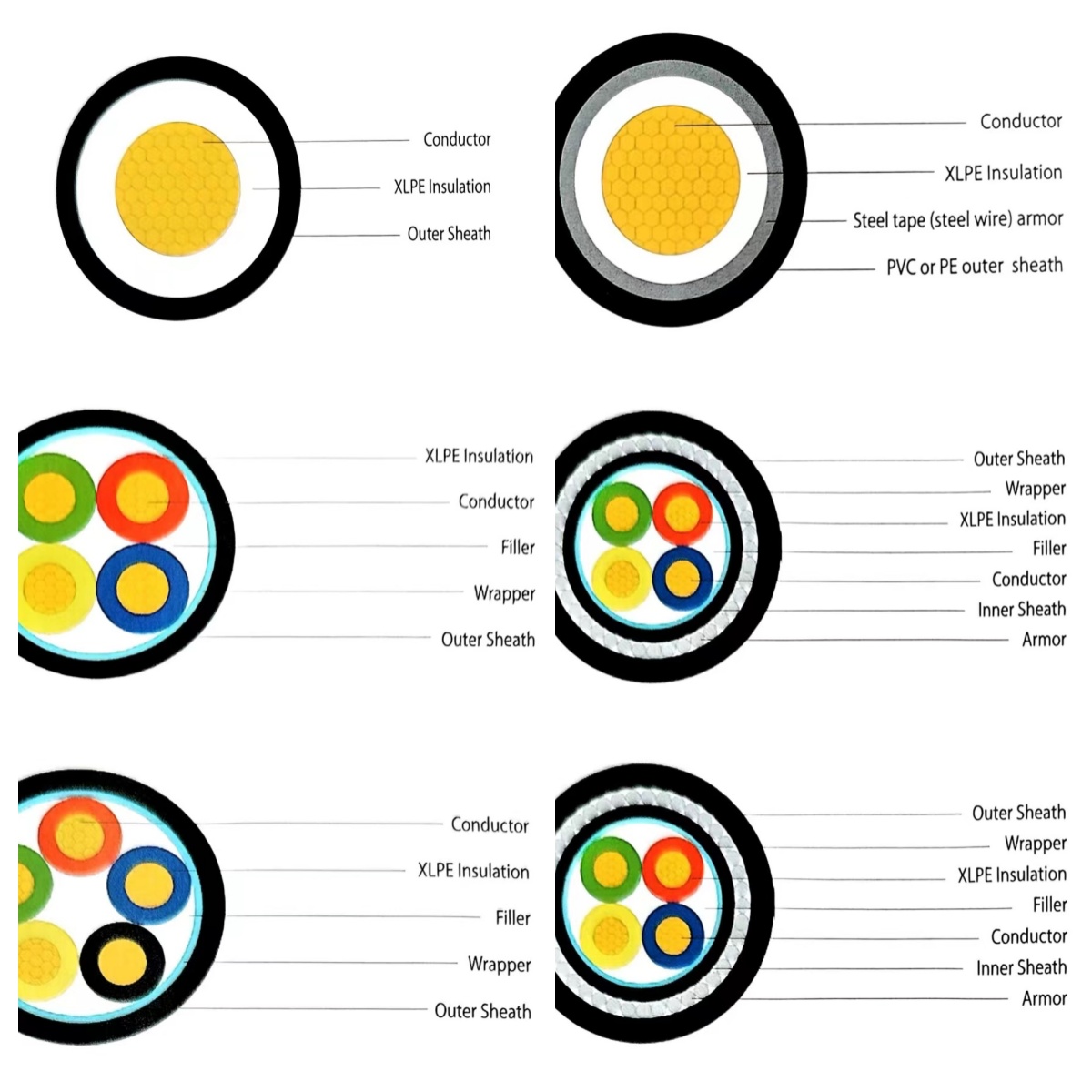
Conductor: High - purity electrolytic copper is selected. This kind of copper has excellent conductive and mechanical properties. After precision processing, its surface is smooth, without defects such as burrs and cracks, ensuring the smooth transmission of current.
Inner insulation: Cross - linked polyethylene (XLPE) material is used. XLPE is a kind of polyethylene that has undergone cross - linking reaction. Compared with ordinary polyethylene, its heat resistance, mechanical strength, chemical corrosion resistance, etc. have been significantly improved. Through special cross - linking processes, such as peroxide cross - linking and silane cross - linking, the polyethylene molecules form a three - dimensional network structure, thus endowing the material with excellent performance.
Outer sheath: Weather - resistant polyvinyl chloride (PVC) material is chosen. PVC is a commonly used plastic material with good mechanical properties, insulation properties and processing properties. In order to improve its weather resistance, additives such as antioxidants and ultraviolet absorbers are added to the material, enabling it to be used in outdoor environments for a long time without being easily aged.
Style
Conductor manufacturing: First, high - purity electrolytic copper ingots are smelted, then made into copper rods through continuous casting and rolling processes, and then drawn into Copper Wires of the required diameter by a wire drawing machine. The copper wires are annealed to eliminate internal stress and improve their flexibility and conductive performance. Finally, multiple copper wires are twisted together to form the cable conductor.
Inner insulation extrusion: An extruder is used to extrude and coat the XLPE material on the surface of the conductor to form the inner insulation layer. During the extrusion process, it is necessary to strictly control parameters such as extrusion temperature and speed to ensure that the insulation layer has a uniform thickness, a smooth surface and is closely combined with the conductor. After extrusion, the insulation layer is cross - linked. According to different cross - linking processes, corresponding heating methods, such as steam heating and hot air heating, are adopted to make the XLPE material complete the cross - linking reaction.
Outer sheath extrusion: After the inner insulation layer is cooled and solidified, the extruder is used again to extrude and coat the PVC material on it to form the outer sheath. Similarly, it is necessary to control the extrusion parameters to ensure that the sheath has a uniform thickness, good surface quality and is closely attached to the inner insulation layer.
Finished product inspection: After the cable is produced, a series of inspection items need to be carried out, such as appearance inspection, size measurement, electrical performance testing (including insulation resistance test, withstand voltage test, etc.), mechanical performance testing (including tensile strength, elongation at break, etc.), to ensure that the product meets relevant standards and technical requirements. Only qualified products can leave the factory.
Packaging method: Cables are usually packaged with cable reels. According to the length and cross - sectional specification of the cable, a cable reel of appropriate size is selected. There are two types of cable reels: wooden cable reels and steel cable reels. For cables with a shorter length, they can also be packaged in coils, wrapped with plastic film or woven bags.
Packaging marking: On the cable reel or package, the product name, model specification, length, production date, manufacturer, execution standard and other information are clearly marked. At the same time, some warning signs, such as "Do not press heavily" and "Moisture - proof", will also be marked.
Packaging requirements: The packaging should be firm and reliable, and can protect the cable from damage during transportation and storage. The cable should be neatly wound on the cable reel without twisting or knotting, and both ends should be sealed to prevent moisture, dust, etc. from entering.
Transportation method: According to the quantity, length and transportation distance of the cables, road transportation, railway transportation, waterway transportation and other methods can be selected. Road transportation usually uses trucks, railway transportation uses boxcars or containers, and waterway transportation uses cargo ships.
Transportation precautions: During transportation, the cables should be prevented from being subjected to severe impact, extrusion, exposure to sunlight, rain, etc. The cable reel should be kept in an upright state and firmly fixed with ropes to prevent rolling and tilting during transportation. For coiled cables, avoid stacking them too high to prevent damage to the lower cables.
Loading and unloading requirements: When loading and unloading cables, special hoisting equipment, such as cranes and forklifts, should be used, and rough loading and unloading is strictly prohibited. When hoisting, the slings should be tied to the special lifting rings of the cable reel to avoid damaging the cables and the cable reel.
Delivery process: After the customer places an order, the warehouse management personnel check the product's model specification, quantity, etc. according to the order information, and arrange delivery after confirmation. Before delivery, the cables are re - inspected to ensure that the product quality is qualified. Then, packaging is done in accordance with the packaging requirements, and the transportation company is contacted to arrange the transportation vehicles and transportation time.
Delivery time: When the inventory is sufficient, delivery is usually completed within 1 - 3 working days after receiving the order. For customized products or large - quantity orders, the delivery time will be appropriately extended according to the production progress, and the specific time will be communicated with the customer in advance.
Logistics tracking: After delivery, the logistics information, including the name of the transportation company and the waybill number, is timely fed back to the customer to facilitate the customer to query the transportation status of the goods.
Sample provision: For customers with sample needs, the company can provide free samples, but the number of samples is usually limited, generally 1 - 2 meters. The customer needs to bear the transportation cost of the samples.
Sample application: Customers can apply for samples from the company by phone, email, online customer service, etc., indicating the model specification, quantity and other information of the required samples. After receiving the application, the company will arrange the preparation and delivery of the samples as soon as possible.
Sample confirmation: After receiving the samples, the customer should inspect them in a timely manner to confirm whether the samples meet the requirements. If there are any questions or objections to the samples, the customer should communicate with the company in a timely manner.
Quality assurance: The company promises that the sold cable products meet relevant national standards and industry standards, and the product quality guarantee period is 18 months from the date of delivery. Within the quality guarantee period, if the product has quality problems caused by non - man - made factors, the company will be responsible for free repair or replacement.
After - sales service team: The company has a special after - sales service team composed of professional technical personnel, which can provide customers with timely and effective after - sales service. Customers can contact the after - sales service team by phone, email, etc. to consult about product use, maintenance and other issues, or feedback product quality problems.
Fault handling: If the customer reports a product quality problem, the after - sales service team will respond within 24 hours, understand the problem situation, and arrange technical personnel to go to the site for testing and handling according to the actual situation. For products that need to be repaired or replaced, the company will handle them in a timely manner in accordance with relevant regulations to ensure the normal use of the customer.
Technical support: The company also provides customers with technical support services, including cable selection suggestions, installation guidance, fault diagnosis, etc. During the process of cable installation and use, customers can consult the company about any technical problems, and the company will provide professional solutions.


Hongtai Kablo Teknoloji Co., Ltd
E-posta: Export@qlcables.com
sales@qlcables.com
Tel/whatsapp:+86-18032066271
Ekle : Xiaokou Endüstriyel Kalkınma Bölgesi, Ningjin County, Xingtai City , Hebei Eyaleti, Çin
Telif Hakkı © Hongtai Cable Technology Co., Ltd Teknik Destek:Ronglida teknolojisi
Bu web sitesi, web sitemizde en iyi deneyimi yaşamanızı sağlamak için çerezleri kullanır.
 English
 Español
 Portugues
 Pусский
 Français
 العربية
 ไทย
ไทย Indonesia
 Tiếng Việt



 Telefon
 Posta
Posta